Alex Melen’s Insights

We caught up with the brilliant and insightful Alex Melen a few weeks ago and have shared our conversation below.

Alex, appreciate you joining us today. Getting that first client is always an exciting milestone. Can you talk to us about how you got your first customer who wasn’t a friend, family, or acquaintance?

In the late 90s, the internet felt like the Wild West—full of potential, but completely unorganized. I was just a teenager with a passion for code and a few servers I’d managed to string together. While most kids were focused on high school sports, I was obsessed with the idea of T35 Hosting providing a platform where anyone could build a home on the web for free.

The story of that first “real” dollar didn’t actually come from a direct sales pitch; it came from the sheer scale of the community we were building.
The Scene: A Bedroom in New Jersey

Picture a bedroom filled with the hum of hardware and the glow of CRT monitors. I had launched T35 as a free hosting provider, and the growth was explosive. We were hitting millions of page views, but as any entrepreneur knows, “growth” without “revenue” is just a very expensive hobby.

The “Aha” Moment

The first dollar didn’t come from a cousin or a neighbor. It came from a global advertiser.

I realized that the real value of T35 wasn’t just the hosting; it was the eyeballs. I decided to implement a small banner ad system for the free sites we hosted. I remember the nerves of hitting “deploy” on that code, wondering if the users would revolt. Instead, the system held, and the ads started serving.

The First Dollar

I remember logging into our primitive affiliate dashboard a few days later. I saw a number that wasn’t zero. It was a few dollars and some change—revenue generated by a user I had never met, living in a country I had never been to, who had clicked an ad on a site I was hosting.

The feeling was electric. * It wasn’t about the amount; it was the validation of the model.

It was the moment T35 transitioned from a project to a business.

I realized that I had created something that could generate value while I was at school, while I was sleeping, and while I was dreaming up the next big feature.

That first dollar proved that a kid with a server could compete with the giants. It gave me the “entrepreneurial bug” that has stayed with me through every keynote and every agency milestone since. It wasn’t just revenue; it was proof of concept for a lifetime of digital marketing.

Great, appreciate you sharing that with us. Before we ask you to share more of your insights, can you take a moment to introduce yourself and how you got to where you are today to our readers.

The Founder’s Journey: Alex Melen

I’ve been building the internet since 1997. My career started in a New Jersey bedroom where I founded T35 Hosting, growing it into one of the world’s largest free web hosting providers before I was even out of high school. That early “trial by fire” in managing millions of users taught me the most valuable lesson in business: In the digital world, visibility is the only currency that matters.
The Mission: SmartSites

Today, as the co-founder of SmartSites, I help brands bridge the gap between having a great product and actually being found. We specialize in high-performance SEO, PPC, and Web Design. The core problem I solve for my clients is digital inefficiency. Most businesses are shouting into a void; I provide the megaphone and the map to ensure their marketing spend translates into measurable ROI.
The “Alex Melen” Edge

What sets me apart is a technical-first DNA. I don’t just understand marketing; I understand the “pipes” of the internet. Whether I’m consulting for a Fortune 500 brand or delivering a keynote, I bring a level of analytical rigor—honed from decades of hosting and coding—that traditional agencies simply can’t match.
The Bottom Line

I’m most proud of building a multi-award-winning agency that remains obsessed with client results. To my followers and potential partners: I don’t follow digital trends; I look at the data to see where the puck is going next. My brand is built on transparency, technical excellence, and a relentless “never-settle” attitude.

Let’s talk M&A – we’d love to hear your about your experience with buying businesses.

To be direct: No, I have never bought a business. While the modern entrepreneurial landscape is obsessed with M&A (Mergers and Acquisitions) as a “fast track” to scaling, I’ve always been a firm believer in the organic, ground-up build. For me, the thrill of entrepreneurship isn’t in managing a portfolio; it’s in the engineering of growth.
The Philosophy: Building on a Solid Foundation

When you buy a business, you aren’t just buying revenue—you’re buying someone else’s technical debt, their cultural quirks, and their structural compromises. My career, from T35 Hosting to SmartSites, has been defined by a “technical-first” DNA. I believe that for a business to be truly scalable and resilient, the foundation has to be laid correctly from Day One.

Purity of Vision: I enjoy the “blank canvas” phase. I want to know that every line of code, every SOP, and every client strategy was built with our high standards of excellence.

Manual Growth vs. Artificial Scale: Scaling through acquisition often masks underlying inefficiencies. I prefer the “manual” grind of organic growth because it forces you to actually solve problems rather than just out-spending them.

My Skillset: The Engine of Growth

My specific skillset isn’t in “fixing” or “rebuilding” other people’s visions—it’s in generating momentum. I am a growth architect. I find the most professional fulfillment in taking a raw idea and building the systems, the SEO strategies, and the technical infrastructure to turn it into a market leader.

When you build from the ground up, you have an intimate, granular understanding of the business that a “buyer” can never replicate. You know where every “bolt” is tightened.
The Bottom Line

I don’t believe in “buying” business; I believe in earning it. While others are busy navigating the complexities of integration and due diligence, I’m busy refining the engine of growth that sets my brands apart. My pride comes from looking at a global entity and knowing that every brick in that wall was placed with intent.

What do you think helped you build your reputation within your market?

The Currency of Trust: How I Built My Reputation

In an industry as fast-moving and often “noisy” as digital marketing, reputation isn’t built on a single viral post or a lucky campaign. It’s built on compounded consistency. My reputation in the market is the result of nearly three decades of “showing up” exactly where the industry needs expertise.

1. Radical Consistency

The foundation of my brand is simply staying in the game. From the early days of T35 Hosting in the 90s to the global scale of SmartSites today, I haven’t jumped from trend to trend. I’ve stayed focused on the technical architecture of growth. Clients and peers trust me because I have a decades-long track record of stability. In an era of “fly-by-night” consultants, being a constant fixture is a competitive advantage.

2. The Power of the Stage

Public speaking has been a massive pillar for my reputation. There is a specific kind of trust that is formed when you stand in front of a room of your peers and break down complex strategies. Whether it’s at a major tech conference or an industry summit, speaking allows me to move from “service provider” to educator. It proves that I don’t just use these tools—I help define how they are used.

3. Authorial Authority

Writing books and high-level industry contributions acts as my “permanent record.” A book is a stake in the ground; it says, “I’ve thought about this deeply enough to systematize it.” It provides a level of vetting that a website or an ad never could. When a potential client sees that I’ve literally written the book on the strategies we’re deploying, the “sales” conversation is already halfway over.

4. Protecting the “Social Proof”

Reputation is what people say about you when you aren’t in the room. I’ve always prioritized the long-term relationship over the short-term win. Because I believe in building manually from the ground up, I’m deeply invested in the success of every project. That commitment creates a cycle of referrals and testimonials that has become the engine of my growth.
The Bottom Line

I didn’t “buy” my reputation, and I didn’t inherit it. I built it brick-by-brick through presence, publication, and performance. I want people to see my name and think of technical excellence and unwavering reliability.

Contact Info:

Alex Melen of NYC on Life, Lessons & Legacy

Alex Melen shared their story and experiences with us recently and you can find our conversation below.

Alex, a huge thanks to you for investing the time to share your wisdom with those who are seeking it. We think it’s so important for us to share stories with our neighbors, friends and community because knowledge multiples when we share with each other. Let’s jump in: What do you think is misunderstood about your business?

One of the biggest misconceptions about digital marketing is on the SEO side. Too many still believe that SEO is some kind of mysterious black box. Too many agencies still sell it that way: vague promises, unclear deliverables, and a lot of smoke and mirrors. But the truth is, SEO isn’t magic. It’s work. Real, measurable, strategic work.

At SmartSites, we’ve built our reputation by demystifying that process. SEO is about putting in the hours—consistently and intelligently. It’s content creation that actually answers what people are searching for. It’s link building that earns trust and authority. It’s fixing technical issues that prevent search engines from even seeing your site properly. There’s no shortcut, no secret sauce—just a relentless focus on doing the right things, the right way, over time.

What’s misunderstood is that SEO isn’t a one-time fix or a plug-and-play tool. It’s a long-term investment in visibility, credibility, and growth. And when done transparently and strategically, it delivers results that compound. That’s what we do at SmartSites—and that’s why we’ve stayed ahead in an industry that’s constantly evolving.

Can you briefly introduce yourself and share what makes you or your brand unique?

Hi, I’m Alex Melen—an entrepreneur, keynote speaker, and digital marketing enthusiast who’s been riding the wave of online innovation since the dial-up days. I co-founded SmartSites with a simple mission: to build a digital agency that actually delivers results, not just buzzwords. What started as a small team of digital visionaries has grown into a global force—over 400 full-time employees across six offices, serving clients in virtually every industry.

SmartSites has been recognized by AdWeek and the Inc. 5000 for multiple consecutive years, and we’re proud to be America’s top-rated digital marketing agency. What makes us different? We’re relentlessly data-driven, obsessively customer-focused, and we believe transparency beats gimmicks every time.

Over the past three decades, I’ve had the privilege of keynoting nearly a hundred conferences and being featured in outlets like Forbes, Bloomberg, NPR, and Business Week’s Top 25 Entrepreneurs. But what drives me most is helping businesses grow—whether it’s through smarter SEO, sharper paid media, or simply making digital work harder for them.

Right now, I’m focused on scaling SmartSites while continuing to push the boundaries of what digital marketing can do. It’s an exciting time to be in this space—and I’m grateful to be part of shaping its future.

Okay, so here’s a deep one: Who saw you clearly before you could see yourself?

Honestly, for me, it was quite the opposite. It wasn’t someone seeing my potential early—it was the overwhelming number of people who didn’t. Back when I was diving into digital in the late 90’s, most people didn’t understand the space, didn’t believe in its future, and certainly didn’t see what I could build within it. That skepticism, that lack of belief, became fuel.

It pushed me to prove what digital could do—not just for me, but for businesses everywhere. It’s what drove me to co-found SmartSites and grow it into one of the fastest-growing digital agencies in America. Every time someone underestimated the power of SEO, or dismissed digital marketing as a trend, it reinforced my belief that I was on the right path.

So while I didn’t have someone who saw me clearly before I saw myself, I had something just as powerful: resistance. And that resistance helped me sharpen my vision, build resilience, and ultimately create something that speaks for itself.

Was there ever a time you almost gave up?

I’ve never been someone who gives up easily—there’ve been very few moments in my life where I seriously considered walking away from something I believed in. But one moment stands out clearly: the early days of my first startup, T35 Hosting.

Back in the late ’90s and early 2000s, the internet was still the Wild West, and the legal system hadn’t quite caught up to the digital age. One day, I was forced to temporarily shut down the entire business because of content a client had hosted on our servers. It was a gut punch. I was young, building something from scratch, and suddenly it felt like the rug had been pulled out from under me.

I was only out of the game for a few weeks, but in that time, I had a chance to reflect—on how far I’d come, what I’d built, and what I still believed was possible. That pause didn’t break me. It recharged me. I came back stronger, re-launched T35 Hosting, and scaled it even further. It’s still running today, decades later.

That experience taught me that setbacks aren’t signs to quit—they’re signals to reassess, refocus, and come back sharper. And that mindset has carried through everything I’ve built since, including SmartSites.

Next, maybe we can discuss some of your foundational philosophies and views? Is the public version of you the real you?

Absolutely. I’ve never seen the point in putting on a persona. Every personal interaction I have—whether it’s on stage, in a meeting, or just grabbing coffee—is always the real me. I don’t have a curated version or a filtered facade. What you see is what you get.

Even in my book, Automotive Search Marketing, I laid it all out—no secrets, no fluff. Just straight-up me and the exact steps I’ve taken to help hundreds of dealerships improve their digital marketing. Whether I’m writing, speaking at a conference, or working with clients day-to-day, I bring the same energy, the same mindset, and the same transparency.

Honestly, it would be way too much effort not to be myself. And in this industry—where trust and authenticity matter more than ever—I think being real is the most valuable thing you can offer.

Okay, we’ve made it essentially to the end. One last question before you go. What are you doing today that won’t pay off for 7–10 years?

If we’re talking strictly ROI, then a lot of what I do outside of work probably won’t “pay off” in the traditional sense—and I’m perfectly okay with that.

I’m a huge automotive enthusiast. I follow car news religiously, dive deep into forums, track model releases, and obsess over engineering details most people overlook. Same goes for travel—I’ll go out of my way to book specific flight paths or aircraft types just for the experience. It takes time, planning, and a lot of nerding out. But it’s what I love.

These passions might not directly impact SmartSites or my next business move, and they probably won’t pay off in 7–10 years. But I believe you have to spend at least part of your time doing something that fuels you—not because it’s strategic, but because it’s fulfilling. That energy, that curiosity, that joy—it spills over into everything else I do. And in the long run, that’s a kind of payoff too.

5 Predictions for Automotive Websites, SEO, and Pay Per Click for 2024 and Beyond

As we kick off 2024, we thought it’d be a great opportunity get the views of two digital marketing experts in automotive: SmartSites’ Alex Melen and Overfuel’s Alex Griffis.

There were no shortage of events in 2023 for the automotive industry–more emerging technologies, increasing popularity of online car-buying, and most importantly, the advances in generative Artificial Intelligence (AI). The way consumers interact with the automotive industry continued to shift over the course of the year, creating new challenges for dealerships to keep pace in a fast-changing environment.

As we look at 2024, how much of an impact will AI have? How is advertising strategy changing? Overall, what does 2024 hold for dealerships and their digital presence? Let’s hear what Melen and Griffis have to say.

What was a surprising trend in 2023 that’s likely to carry over into 2024?

Alex Melen: “Seeing pay-per-click advertising costs continue to increase (a trend that will continue into 2024). As more and more dealers shift their spending to digital, search marketing (Google Ads, Microsoft Ads) continues to attract the lion’s share of the budget, driving up costs. As a result, 2023 experienced one of the biggest jumps in cost-per-click increases in the last few years. That said, search marketing continues to be the best platform for car dealership—and will become even more so with the deprecation of cookies and third-party data. Search continues to be one of the few places in the world where consumers self-identify their intent (i.e.: search for “audi q5 lease deal” or “audi dealership near me”)—allowing advertisers to bid on the specific audiences and self-identified intent.”

Alex Griffis:“One of the most exciting surprises was hearing dealerships use the acronym CWV, or Core Web Vitals, which measures how websites perform based on real-world usage data. It was surprising because, for a long time, we’ve known only 39% of automotive websites achieve good CWB ratings, making it the second-worst performing industry behind Travel. Dealerships are discovering that poor web performance is coming at a significant opportunity cost, and awareness of this issue will continue to increase in 2024.”

Was there a trend in 2023 that you foresee declining in 2024?

Alex Melen: “I think 2024 will mark the end of the minimalist effort and attitudes we’ve seen across auto over the last three years. After some very profitable years in the industry (where demand outstripped supply), I think auto will return to the basics of working hard for every sale and every opportunity across every job function. This applies to vendors just as much as dealership employees—I’ve seen many vendors get by with minimal effort over the last few years, delivering minimal value for the dealership. I believe 2024 will be the year of re-evaluation of both internal strategies at dealerships, their external vendors, and their marketing activities.”

Alex Griffis:“It may not be the most popular opinion, but I foresee the use of live chat products, especially those that are AI-driven, struggling for adoption for three reasons: One, it’s no secret that AI was all the rage last year and many automotive companies joined the race, resulting in clunky products that sold cars for $1. Second, there’s a growing distrust between consumers and AI-based products. Storyblok, a content management system (CMS), revealed that 85% of consumers aren’t interested in using AI to help them make a purchase. Lastly, based on analytics data we’ve collected, live chat has a negative impact on conversion rates when implemented poorly. On vehicle pages, clicking the ‘close’ button on live chat accounted for 20% of all clicks.”

As we kick off 2024, what should be on dealerships’ radars?

Alex Melen: “2024—more even than 2023—will be the year of change. From challenging market conditions, to cookie tracking going away, to the rise of AI and Google’s Search Generative Experience. As I preached during the start of the COVID years, dealerships will need to be agile and proactive (vs reactive). As we saw during the pandemic, the dealerships that were agile and able to adapt profited greatly. Those that weren’t, are no longer in business—despite two record years that followed the start of COVID.”

Alex Griffis: “Website speed, hands down. Over the course of 2023, we saw clients increase organic search traffic by 200-300% by simply making speed a priority and paying close attention to CWV. In March 2024, Google is reportedly releasing new metrics and standards for website responsiveness, which will put even more pressure on dealerships whose websites perform poorly on mobile. Since we’re seeing over 80% of website traffic originating from a mobile device, solving the performance issues are a must.”

What role will AI play in automotive for 2024?

Alex Melen: “Generative AI has the potential to be extremely impactful—if used correctly. I wrote my book on search marketing just a month shy of the explosion of ChatGPT, and it was done the old-fashioned way: one click at a time. I briefly mentioned the coming Generative AI revolution; however, I assumed that Google would not only devalue AI-generated content but label it as such. Considering that even free tools can identify AI-generated content, it’s a no-brainer that Google, which purchased DeepMind in 2014, would easily be able to identify and label (and potentially penalize) AI content.

However, in February 2023, Google came out with their guidance saying that they will continue to treat content following their current guidelines (following the EEAT model), regardless of how it was created. That said, Google continues to reward content based on Experience, Expertise, Authoritativeness, and Trustworthiness. In most cases, AI-generated content will not meet that criteria and will naturally be devalued in search results.

With that said, Generative AI can be used to help create content ideas, generate first drafts of content, and so forth. For 2024, I believe this new approach will gain traction, and Generative AI will become a tool to help create content. And of course, it still continues to be extremely powerful at helping with your social media content, generating campaign ideas, creating ad-copy, responding to reviews, and so much more.”

Alex Griffis:“AI-based products will continue to surge, but many will fail to launch and that’s okay. To Alex’s point, I think there are opportunities for AI to be used responsibly, like boosting productivity or assisting in content generation. In fact, there are many use cases for AI in automotive that aren’t purely conversational.

A few great examples come to mind. Inventory management is improving through analyzing historical data, crunching numbers, and helping dealerships better price their inventory to be competitive. We’ve started using a model internally for predictive vehicle maintenance and automated outreach to customers. It feels like the focus on conversational AI has totally overlooked the other customer touch points that are more subtle and behind the scenes.

As companies iterate to make automotive AI products better, I think the
most gains will be made in the sales enablement or customer experience
applications.”

How to Leverage ChatGPT for Your Car Dealership

ChatGPT has come out of nowhere to become one of the hottest new topics and tools of the year. For example, looking at Google Search interest over time, searches for ChatGPT were 0 before December 2022 (which makes sense since it only launched in November 2022 – just a few short months ago).

Artificial Intelligence (AI) tools like ChatGPT have become one of today’s most game-changing – and debated – technologies. Reactions from marketers to AI tools have been lukewarm thus far and all over the map in terms of the reaction. Typical responses have ranged from fear of AI taking over their job (and the world!) to asserting AI can’t help them in any way.

The truth – at least for today, lies somewhere in the middle. ChatGPT (Pre-trained Transformer), is an AI-driven chatbot launched by OpenAI in November 2022. Elon Musk has also been extensively involved with OpenAI since the companies founding in 2015 and was part of the team that created the initial OpenAI Charter. However, he resigned from the board in 2018 (after voicing some concerns about potential issues that this publicly- available AI can cause).

ChatGPT, in its current release, is a powerful tool that can help create content, generate ideas, and draft documents – all automatically on the fly. While there are some concerns that it will ultimately make manual SEO content creation obsolete, for the time being – the manual component of content creation will still reign as king. There are tools that can identify what content was AI-generated, and I would be shocked if Google doesn’t utilize its own internal AI (don’t forget, the purchased DeepMind back in 2014!) to identify and devalue machine-generated content. My gut feeling is that within the next few quarters, Google will start not only devaluating AI-based content but also identifying it in the search results as such.

So where does it leave marketers? How can they use ChatGPT and any other upcoming AI-based tools to their advantage? At the very least, I encourage everyone to access the tool and play around with it. Spending just 10 minutes on it will give you great insights and ideas of what it can accomplish.

For those ready to dive in and start using it for their SEO strategy – here are some great ways to use it. First, of course, you’ll need to go to ChatGPT and ask it the below questions, for example:

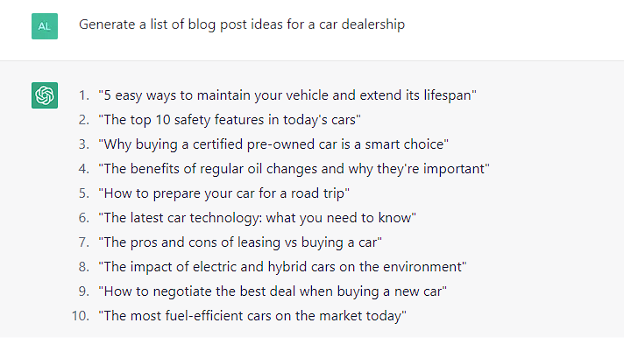
“Generate a list of blog post ideas for a car dealership”

ChatGPT will spit out 10 ideas for blog posts that you can then evaluate and decide which makes sense to write about.

Generate a list of blog post ideas for a car dealership

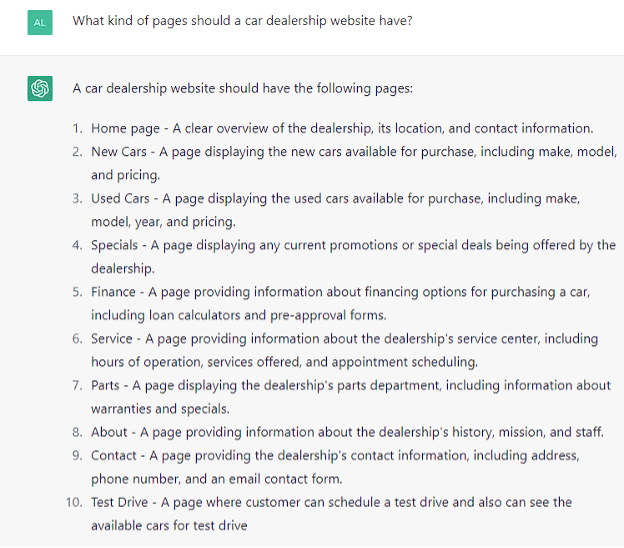
Another great idea is to ask ChatGPT what pages and content you should have on your site. For example:

What types of pages should a car dealership website have?

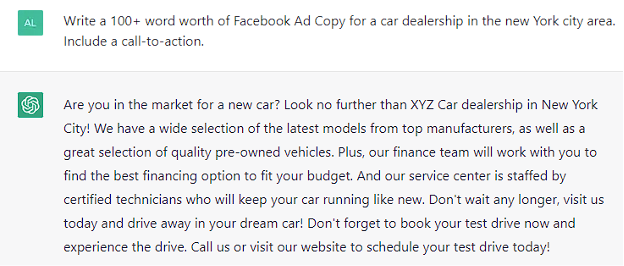
There are also plenty of applications for ChatGPT outside of SEO. For example, social media– where unique human-written content isn’t as important– could really benefit from this AI. For example, try:

Write a 100+ words worth of Facebook Ad Copy for a car dealership in the New York City area. Include a call to action.

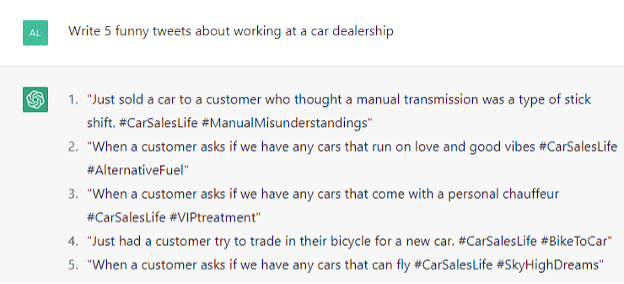
Or perhaps

Write five funny tweets about working at a car dealership

Write five funny tweets about working at a car dealership

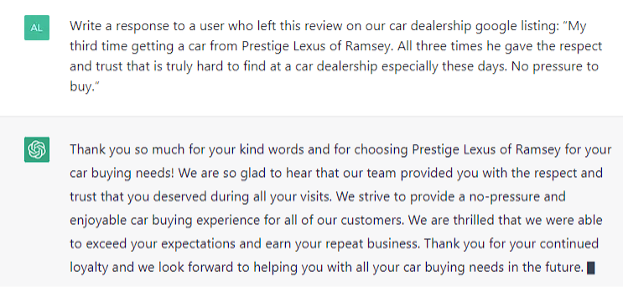
ChatGPT can also be a great tool to help you with writing emails or even responding to client reviews, for example:

Write a response to a user who left this review on our car dealership google listing: “My third time getting a car from Prestige Lexus of Ramsey and Steve Glenwick is my man. All three times, he gave the respect and trust that is truly hard to find at a car dealership, especially these days. No pressure to buy.”

ChatGPT

As you can see, the sky is the limit with ChatGPT and the various AI tools that will follow. But remember, always review what it generates, have a concrete strategy, and apply the human touch! Happy learning!

P.S.: This article was written manually and, aside from the screenshots and examples, was not generated by ChatGPT (I feel like we’ll soon start seeing this kind of disclaimer more and more often).

Original Source: https://read.nxtbook.com/digital_dealer/dealer_magazine/march_april_2023/how_to_leverage_chatgpt_for_y.html

SEOblog Interview: New York City Area SEO Expert Alex Melen from SmartSites

We’re excited to have interviewed New York City SEO Expert Alex Melen from SmartSites for the next installment of our Featured SEO Expert Series!

SmartSites is one of SEOblog’s Top SEO companies in New York City.

Alex Melen is an award-winning entrepreneur and keynote speaker. He is the founder of web hosting company T35 Hosting, founded in 1997, and co-founder of advertising agency SmartSite, founded in 2011. SmartSites now manages over $100MM/year in advertising spend and has six offices and over 350 employees worldwide. SmartSites has been featured in the INC 5000 for six consecutive years as one of the fastest-growing digital agencies. Alex has been featured in Business Week’s Top 25 Entrepreneurs, Bloomberg, Forbes, NPR and more.

SmartSites is an award-winning website design and digital marketing agency, with a focus on search engine optimization (SEO) and pay-per-click (PPC) marketing. SmartSites was founded by brothers Alex and Michael Melen, who grew up with a passion for all things digital. With an innovative vision and a lot of hard work, SmartSites quickly became one of America’s fastest-growing companies. Their relentless focus on their clients has led them to over 100 five-star reviews since our inception in 2011. 

What would you say is unique and/or challenging about the SEO industry in 2023?

“Just like we’ve heard for decades, I’m once again hearing that SEO will be dead in 2023. I believe 2023 will see the rise of machine learning with services like ChatGPT threatening the traditional aspects of SEO. However, I truly believe that the tried-and-true manual content writing will continue to outperform (for 2023, at least!). It will be interested to see how Google and other search engines handle machine-generated content. I believe that Google will soon start highlighting the machine/AI-generated content from content that is manually produced. In 2023 for the very least, we will still have an advantage against the AI.”

How does your agency stand out in a crowded market like the New York city area?

“We continue to pride ourselves on our reputation – which is second to none. Our continuous commitment to our clients continues to shine through. As we have since 2011, we continue to help our customers succeed online.”

Can you share a success story from a local SEO campaign centered around a local area? Include any stats and highlights if possible!

“I’ve personally been very involved in the automotive side of the business. To that extent, we have recently been able to create a how-to resource center for a local Lexus dealership with [hundreds] of pages of content on how people can service, diagnose, and troubleshoot their Lexus. The content started ranking within a few months and now ranks nationally for almost every single page of content. In fact, most now come up in featured snippets and even come up in voice results!”

What is the best advice you ever received in business?

“The best advice I’ve ever received actually was indirectly from my brother and co-founder of SmartSites. It’s something he practices himself – but the advice was to work on the business, not in the business. I often struggle to delegate and think of the bigger picture, but that original concept of working on the business still resonates with me.”

What do you think is the most important quality that makes an agency truly great?

“As an agency, we don’t make any physical goods; we don’t produce any widgets. For us, our employees are our biggest asset. Keeping our employees happy and having them be passionate about what we do continues to be our greatest asset and is what makes our agency great.”

Any predictions for the future of SEO?

“As we briefly discussed in the first question – I believe a big part of SEO is going to be dealing with AI-generated content and automation. Both create a huge challenge for Google in determining what should rank and what shouldn’t. Google themselves have spent huge amounts of money developing their own AI, and I believe we will see them start putting it to use. I also think that AI-generated content will start being highlighted as such, and at least in the short term, will rank worse than manually generated content. It’s certainly an interesting time in SEO, and I think the next two years will see more changes than the previous decade combined.”

What is your reaction when you hear that “SEO is dying”?

“It’s something I’ve been hearing for almost two decades now – as long as we keep hearing it, we’ll know that SEO is still here and is as important as ever.”

What do you think is the most important contributor to keeping clients happy?

“Being passionate about helping your clients succeed (along with generating great results!) will continue to be the most important contributor to keeping clients happy. Happy & passionate employees – dedicated to helping their clients succeed online – is how we all win!”

Interested in being considered as an SEOblog “Featured SEO Expert”? Reach out to our team at info@seoblog.com! We’d love to hear from you and give you a high-traffic platform to share your SEO agency’s story and insights.

Original Source: https://www.seoblog.com/seoblog-interview-new-york-city-area-seo-expert-alex-melen-from-smartsites/

Awards

  • Babson Icon
  • Blomberg
  • Bloomberg Business Work
  • Empact Icon
  • Inc5000
  • Top 25 NJBIZ
  • T35 Hosting Icon
  • Icon YLA
  • Young Biz Icon