When I look at a dealer’s paid search budget, nearly every dollar is usually on Google. Ask about Microsoft Ads and you get some version of “nobody uses Bing.”
I wanted a better answer than that, so we pulled a year of data from 11 of our dealerships that ran search on both platforms. We kept it strictly search versus search: no VLAs, no Performance Max, no feed or display campaigns on either side, so the comparison is fair.
Same searches, very different prices
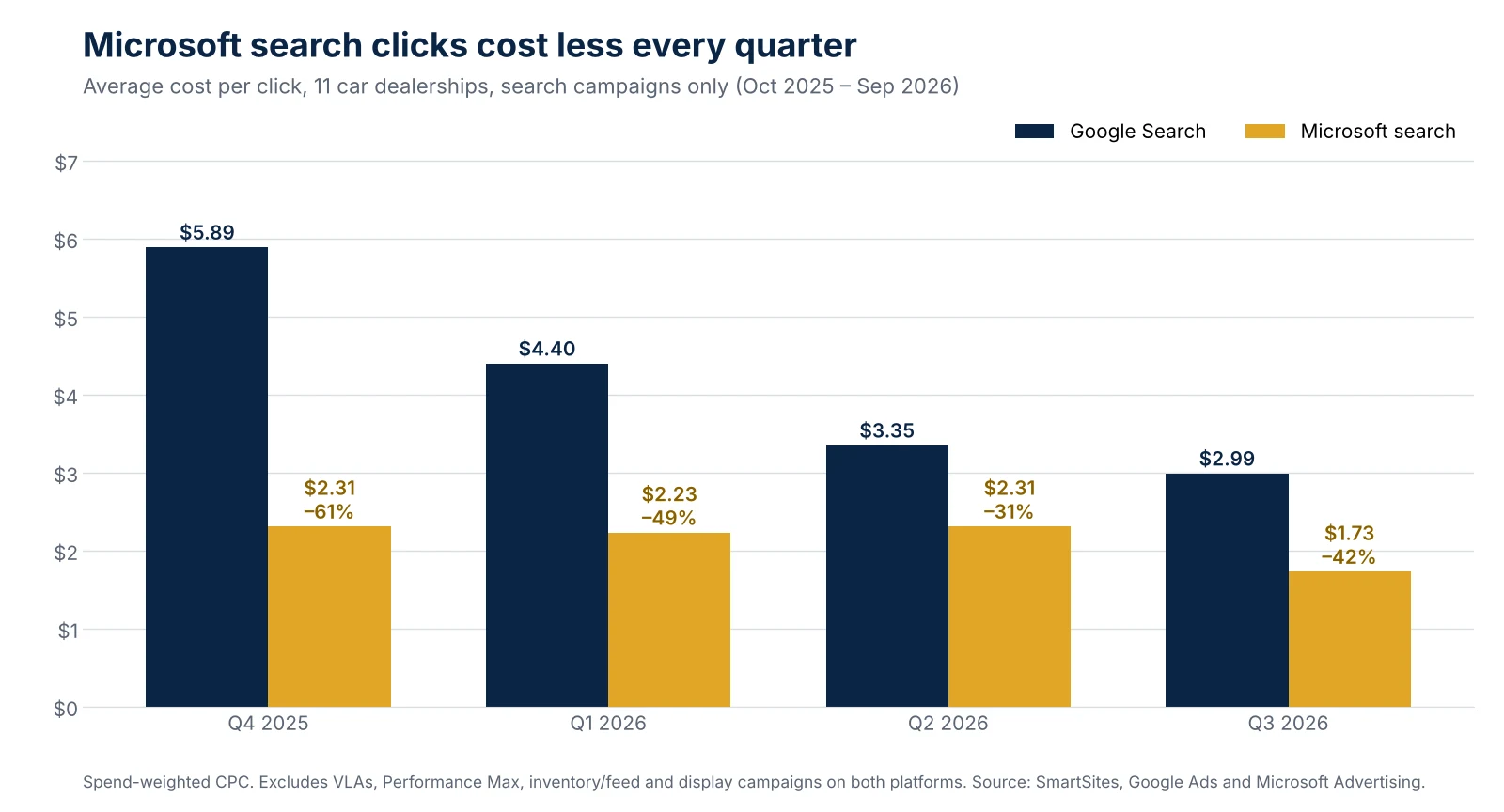
- The average search click cost $2.07 on Microsoft and $3.85 on Google, 46% less.
- Microsoft was cheaper at all 11 stores. The median dealer saved 52% per click.
- It was cheaper in 79 of 82 dealer-months, and in every quarter by 31% to 61%.
- Microsoft took 11% of these dealers’ search spend and delivered 19% of their search clicks.
Luxury stores weren’t the exception, either: they paid 43% less per click on Microsoft, and mainstream stores paid 51% less.
Used cars are where the gap is widest
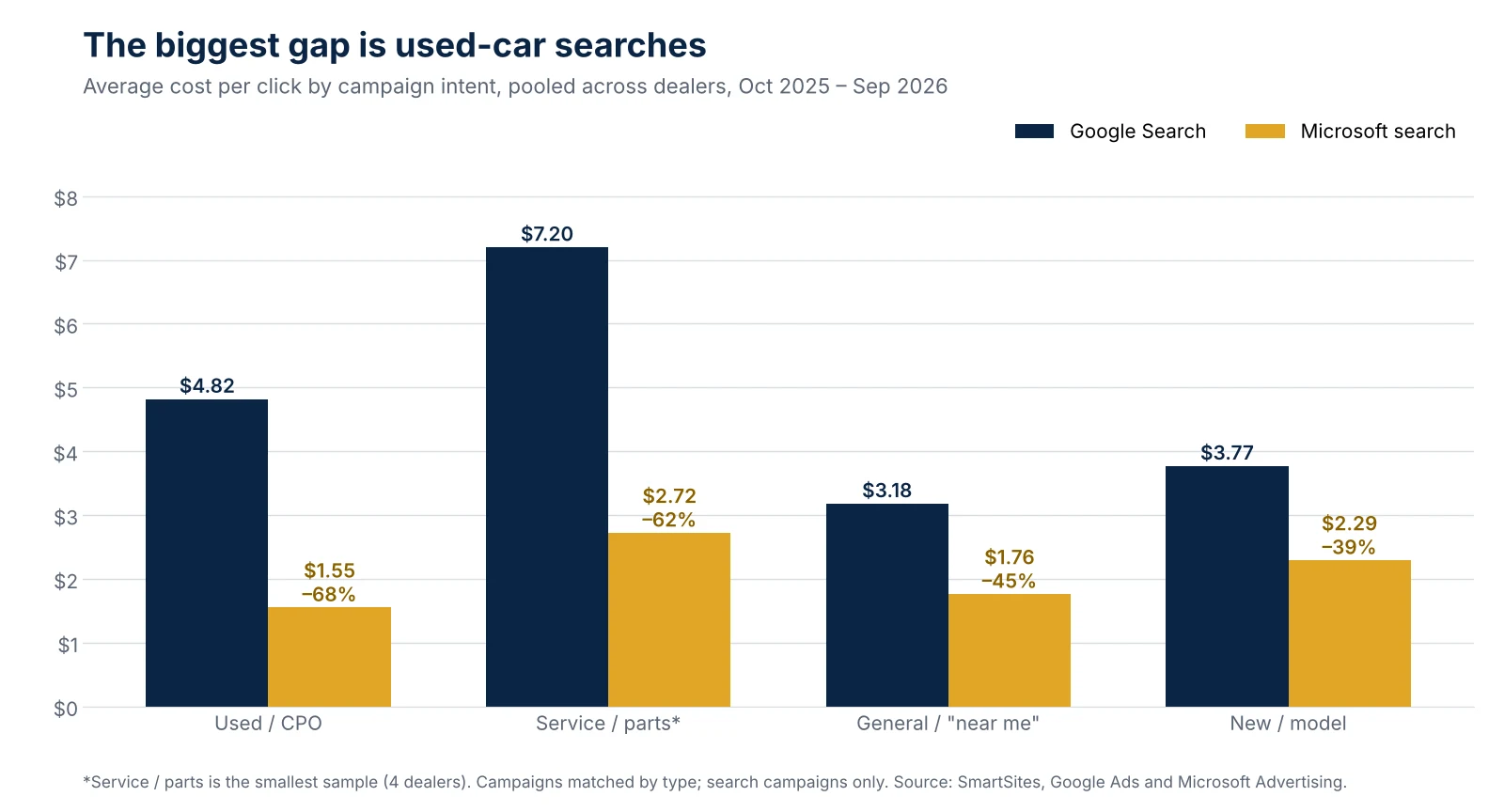
Used and CPO searches cost $1.55 a click on Microsoft vs. $4.82 on Google, a 68% gap. Service and parts was close behind at 62%, though only four stores ran it on both. New-model searches had the smallest gap, and Microsoft was still 39% cheaper.
The reason is simple: fewer dealers bid on Microsoft, so the auction is less crowded. The audience is different too. More than half of Microsoft’s dealer clicks came from desktop (56%, vs. 17% on Google): people researching at work or at home, on Bing, Edge and Windows defaults. Bing also powers Copilot.
The full write-up, with tables and methodology, is on the SmartSites blog.
What I tell dealers now
To be straight about the limits: this is 11 stores one agency manages, mostly in the Northeast, not an industry benchmark. Lower competition is a big part of the price gap, so it may narrow as a dealer scales spend. And because Microsoft Ads doesn’t plug into GA4 the way Google Ads does, most dealers don’t track Microsoft leads the same way. Assuming a search lead converts at a similar rate on either platform, a 46% cheaper click means roughly 40–50% cheaper leads on the same keywords. That’s an assumption, so measure it yourself.
Microsoft won’t replace Google; Google still carries most of the volume. But it’s the cheapest additional search reach most dealers aren’t buying:
- Import your Google Search campaigns and start with used/CPO and service.
- Track calls and forms with Microsoft’s UET tag from day one, so you judge it on cost per lead.
- Run on Microsoft sites and select traffic, not the full partner network.
- Test for 90 days at 10–20% of your Google Search budget, then scale on cost per lead. To grow volume, raise bids: our campaigns lost about 38% of eligible impressions to ad rank and only about 1% to budget.
Full disclosure: SmartSites is a Microsoft Advertising partner. If you want to see what Microsoft Ads could do for your store, reach out. I’m always happy to look at the numbers with you.
— Alex