Dealers keep asking me whether AI search is real yet, or just something agencies like to talk about. So I pulled the numbers from one of our Ford stores in Florida, where we’ve spent this year on both sides of it: getting the store cited by Google’s AI results and ChatGPT, and building the research content shoppers (and AI tools) look for before they buy.
On July 21 we started publishing 44 model and trim research pages for the store. Here’s what happened next.
The research pages took over the store’s Google visibility
The pages answer the questions shoppers ask before they pick a trim — “What’s the difference between the Bronco Badlands and the Outer Banks?” or “Is the F-150 Raptor R worth it?” All 44 are indexed.
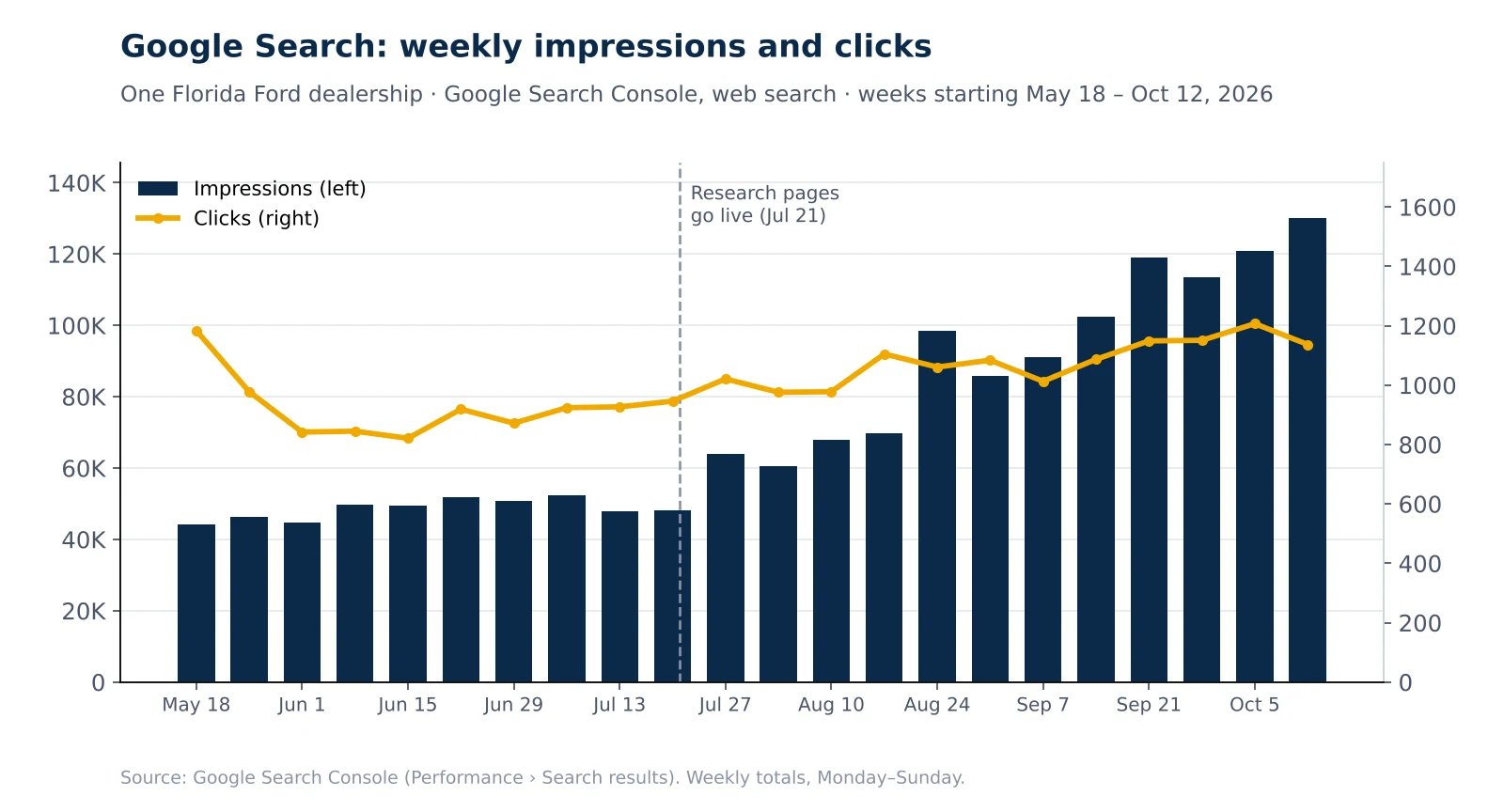
- Weekly Google impressions went from about 48,000 before launch to about 125,000 in October. Weekly clicks rose about 25%.
- Through October 23 the 44 pages earned 607,746 impressions and 2,747 clicks — nearly half the whole site’s Google impressions over the same dates. The F-150 Raptor R comparison alone earned 305,451.
- Visits starting on those pages: 38 in late July, 441 in August, 934 in September and 1,224 in the first 25 days of October.
Google’s AI results started showing the store
Search Console’s new Generative AI features report counts how often a site appears in Google’s AI-generated results. It can only be viewed inside Search Console, not through the API.
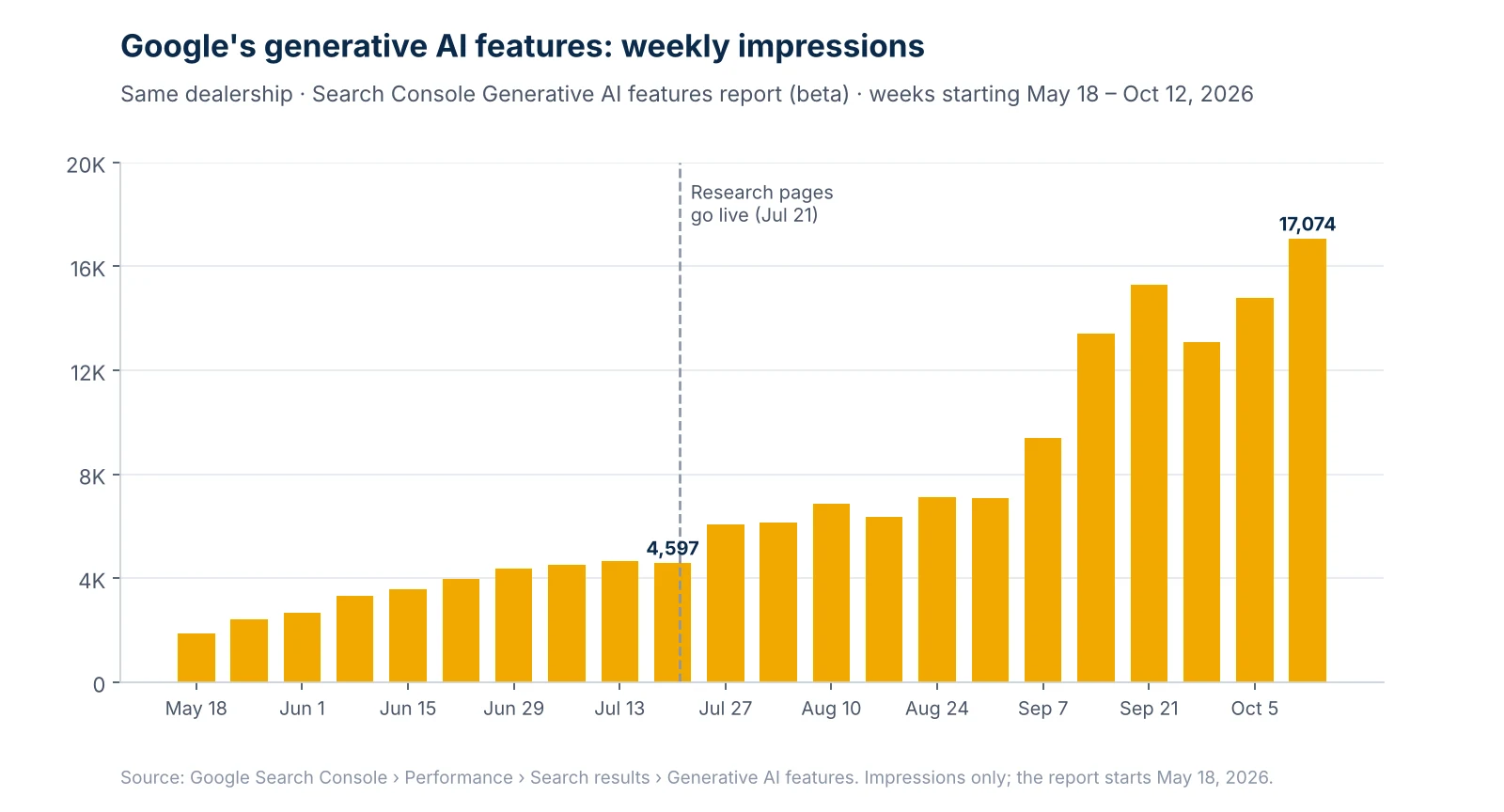
The week the research pages went live, the store had 4,597 impressions in Google’s AI features; the week of October 12 it had 17,074. From July 25 to October 24 the research pages earned more than half of them, and the F-150 Raptor R page alone had 48,701. AI-feature impressions were already rising from a low base before July — what changed is the slope, and which pages were doing the work.
ChatGPT visits more than quadrupled
Counting every GA4 visit from an AI assistant (ChatGPT, Gemini, Perplexity, Copilot, Claude), the store went from 60 AI visits in June to 253 in September, its best month on record and almost five times September 2025. About 97% came from ChatGPT.
What surprised me is where ChatGPT sends people: 56% of AI visits since late July landed directly on a specific new or used vehicle listing, and about two-thirds landed somewhere in inventory. Shoppers ask for a particular kind of truck or SUV near them, and ChatGPT links them straight to a car on the lot.
The full write-up, with tables and methodology, is on the SmartSites blog.
What I tell dealers now
To be straight about the limits: AI-assistant visits are still under 1% of this store’s traffic, the ChatGPT visits mostly go to inventory rather than the research pages, clicks grew far less than impressions, and this is one store, not a lab experiment. But the direction is clear:
- Answer the research questions. Trim comparisons and “which one should I buy” pages earned nearly half the store’s Google impressions and more than half of its impressions in Google’s AI results.
- Treat your vehicle listings as AI landing pages. Accurate pricing, complete specs, real photos and an easy way to contact the store.
- Measure AI on its own: Search Console’s Generative AI features report every month, plus a GA4 report for AI-assistant sources.
If you want to see what AI search looks like for your store, reach out.
— Alex