After I wrote about car dealers overpaying for search clicks, the first question I got was whether that’s just a dealer thing. So we ran the same comparison across every SmartSites client that runs search on both Microsoft Ads and Google Ads.
Same rules as the dealer study: search campaigns only on both sides (no Shopping, Performance Max, display or inventory ads), October 2025 through September 2026, and each advertiser compared with itself only in quarters when it ran both platforms. That left 73 advertisers, 230 advertiser-quarters and about 4.5 million clicks.
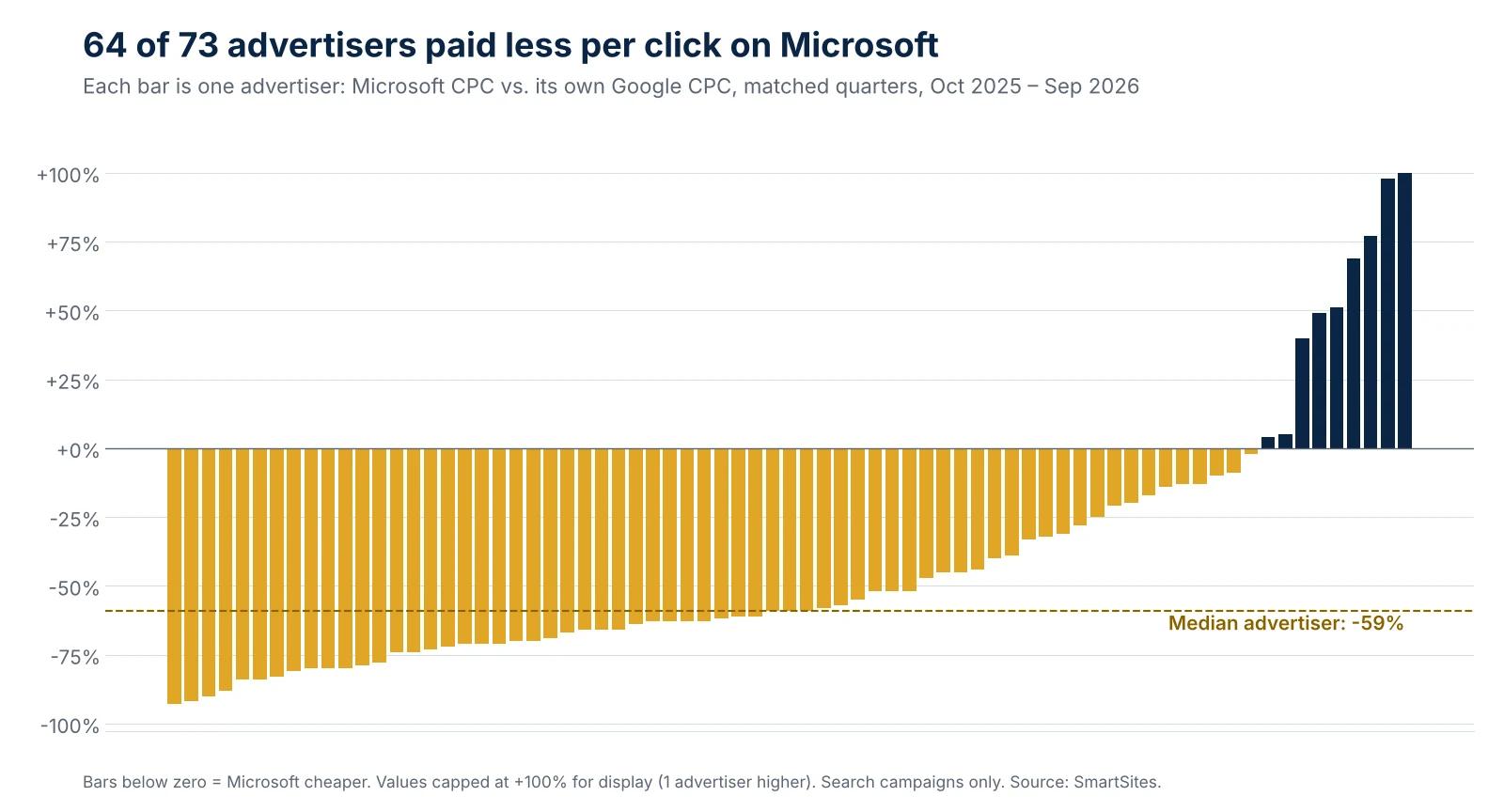
Microsoft was cheaper for 64 of 73 advertisers
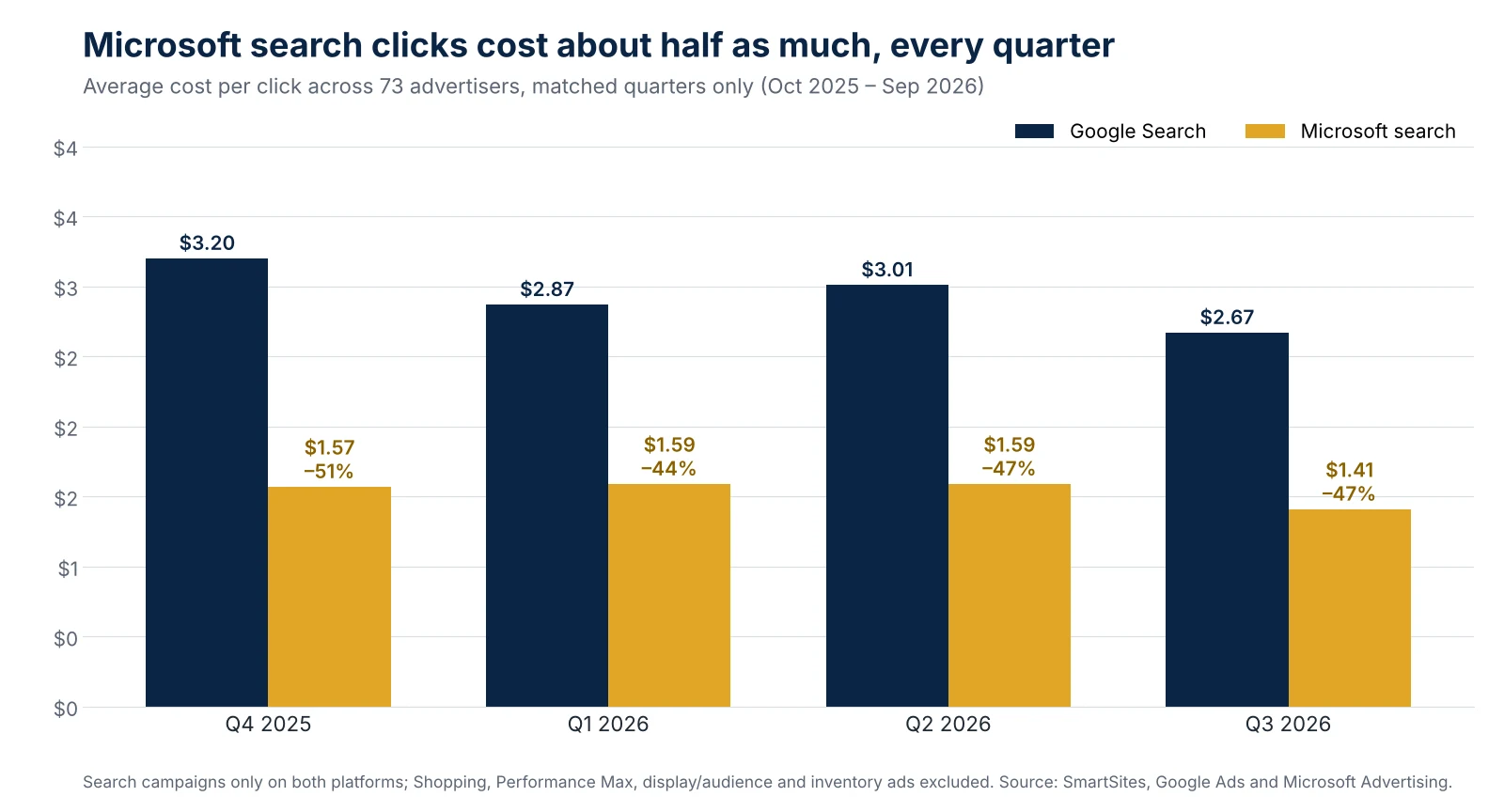
- The average search click cost $1.54 on Microsoft and $2.93 on Google, 47% less. Leaving out the three largest accounts, the gap was 45%.
- 64 of 73 advertisers paid less per click on Microsoft. The median advertiser saved 59%; the middle half saved 25% to 71%.
- The gap held at 44% to 51% in every quarter.
- Microsoft took 17% of these advertisers’ search spend and delivered 29% of their search clicks.
The more you pay Google, the more Microsoft saves
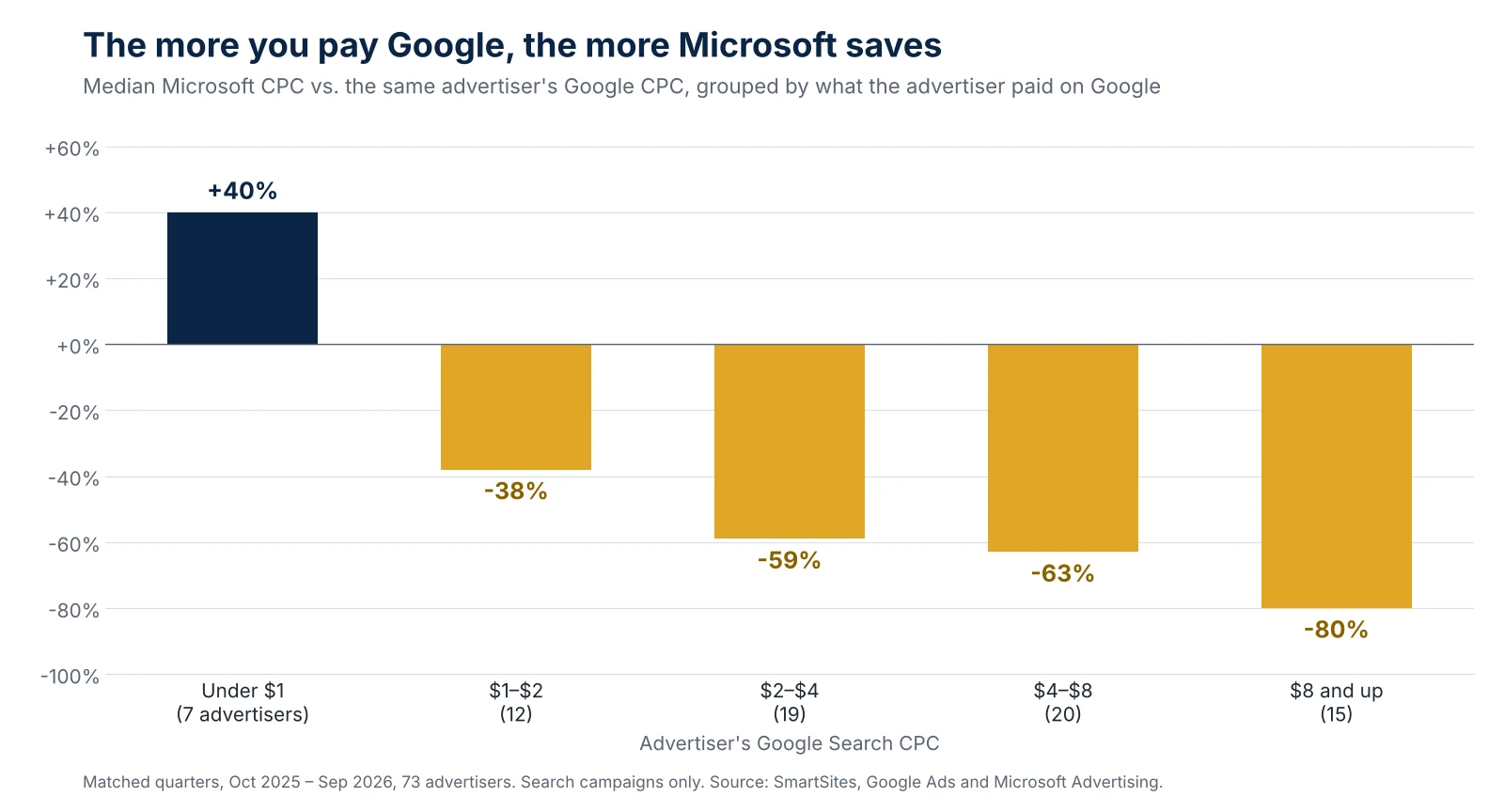
This was the clearest pattern in the data. Advertisers paying $8 or more per click on Google saved a median 80% on Microsoft. Under $1 a click, Microsoft was actually more expensive. Four of the nine advertisers that paid more on Microsoft were already paying under 60 cents a click on Google.
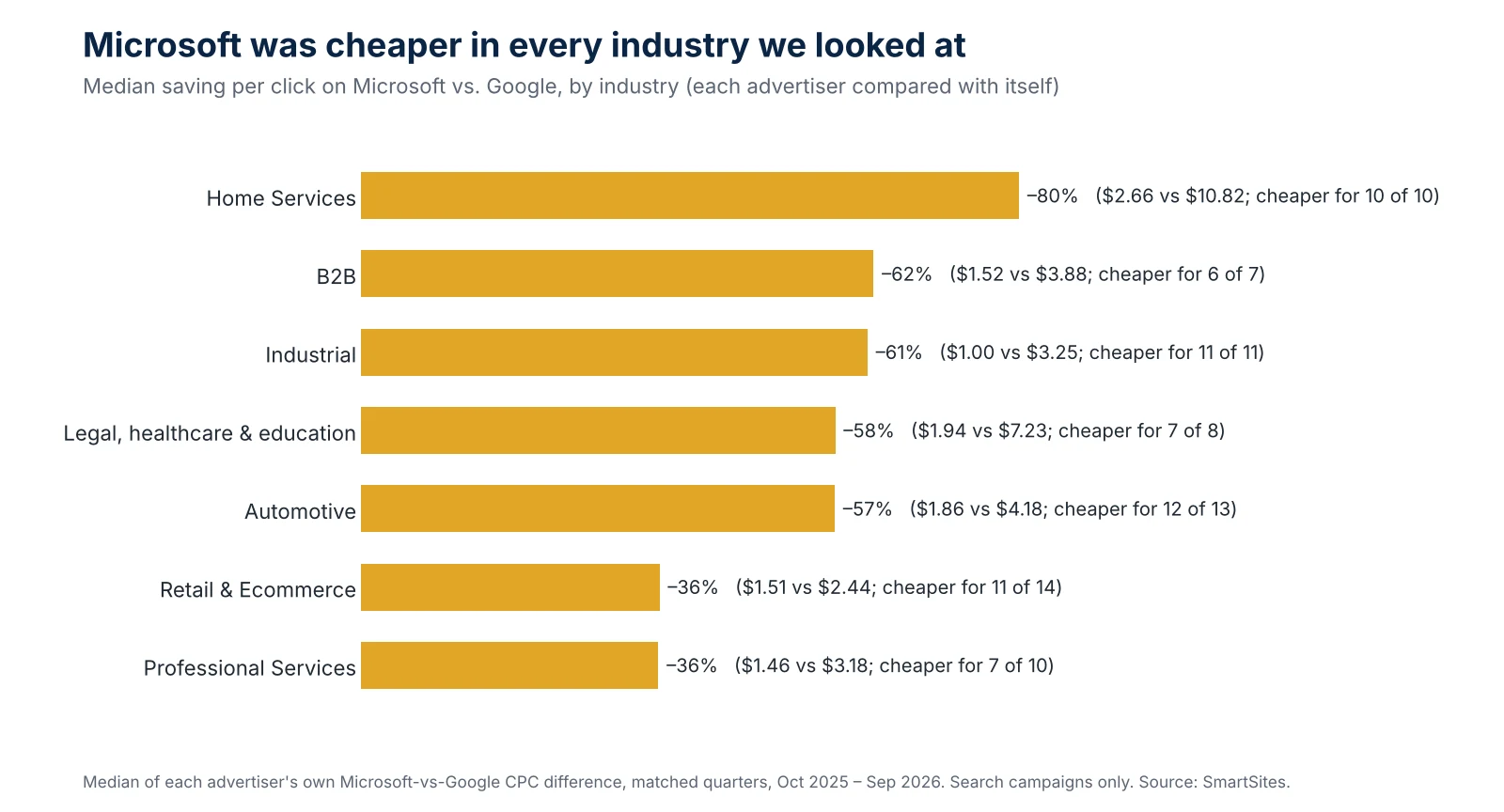
By industry, home services saw the biggest gap (median $2.66 on Microsoft vs. $10.82 on Google), followed by B2B, industrial and automotive. Retail and ecommerce and professional services saved the least, about 36%.
Non-brand is where the savings are
On non-brand searches, Microsoft clicks cost $1.57 vs. $3.56 on Google (–56%). Brand searches were cheaper too, but only by 25% ($1.56 vs. $2.09), because nobody bids much against you for your own name. Non-brand keywords are where the Google auction is crowded and where Microsoft’s thinner competition pays off.
Most advertisers also have room to grow on Microsoft: their search campaigns lost only about 4% of eligible impressions to budget (16% on Google) and about 58% to ad rank. More volume there mostly means higher bids, not bigger budgets.
The full write-up, with tables and methodology, is on the SmartSites blog.
Download the data
Both tables are free to use with attribution (CC BY 4.0). Advertisers are anonymized: no names, no spend, click volumes in bands only.
- Summary table (CSV): overall, by quarter, by industry, brand vs. non-brand, by Google CPC band, impression share.
- Advertiser-level table (CSV): 73 rows with industry, matched quarters, Microsoft CPC and Google CPC.
How it was measured: SmartSites-managed advertisers with at least $500 of Microsoft search spend in the year; a quarter counts only with $100+ and 30+ clicks on each platform. Four of 77 eligible advertisers were excluded (incomplete Microsoft data, inventory-only Microsoft campaigns, too little overlap). Brand vs. non-brand is based on campaign names. This is a convenience sample from one agency, not an industry benchmark.
What I tell advertisers now
To be straight about the limits: lower competition is a big part of the price gap, so it may narrow as you scale. And because conversion tracking isn’t set up the same way on both platforms for many advertisers, I can’t show you a clean cost-per-lead comparison across 73 accounts. Assuming similar conversion rates, a click that costs half as much means a lead that costs about half as much. That’s an assumption, so measure it yourself.
Microsoft won’t replace Google, which still carries most of the volume. But for most advertisers it’s the cheapest additional search reach they aren’t buying:
- Import your Google Search campaigns and lead with non-brand.
- Check what you pay Google. If your non-brand clicks cost $2 or more, Microsoft is very likely cheaper.
- Track calls, forms and sales with Microsoft’s UET tag from day one, so you judge it on cost per lead.
- Run on Microsoft sites and select traffic, not the full partner network.
- Test for 90 days at 10–20% of your Google Search budget, then scale on cost per lead.
Full disclosure: SmartSites is a Microsoft Advertising partner. If you want to see what Microsoft Ads could do for your business, reach out. I’m always happy to look at the numbers with you.
— Alex